
Disrupting e-methanol production
Factory-built, standardised
e-methanol systems
Off-grid systems that turn sunlight, water and air into RFNBO-certified methanol, below the price the penalty sets, and ahead of shipping’s 2034 mandate.
Market opportunity
Methanol is one of the most versatile molecules in the economy, and e-methanol makes it renewable
Almost 100 Mt
Global methanol demand, 2025
Half goes into chemicals, almost a third into fuels and a fifth into plastics.
50%
Chemical derivatives
Formaldehyde, acetic acid
30%
Fuels
And fuel components
20%
Plastics
Methanol-to-olefins
The impact of e-methanol
Renewable methanol replaces fossil methanol without changing the molecule.
A drop-in for every market
Chemically identical to fossil methanol, so buyers change nothing downstream.
A route into hard-to-electrify sectors
E-methanol carries renewable electricity into fuels and chemicals.
Why current solutions fall short
The EPC-led model of bespoke, large-scale e-methanol plants is failing
<4%
Less than 4% of more than 9.3 Mtpa of announced e-methanol capacity has reached final investment decision. The bespoke projects that do get built cannot meet the price ceiling, at an estimated €2,000-2,500/t.
More than 9.3 Mtpa of announced e-methanol capacity across 66 sites tracked by Argus
01
Large-scale premium
Gigawatt-scale plants need large wind or solar build-outs or grid connections, with cabling, inverters, transformers and substations.
02
Bespoke premium
A custom, single-site build costs an estimated 30-50% more than a standardised, replicated design. Each plant carries its own engineering, one-off procurement and site-specific permitting.
Our solution
The McDonald’s of e-methanol
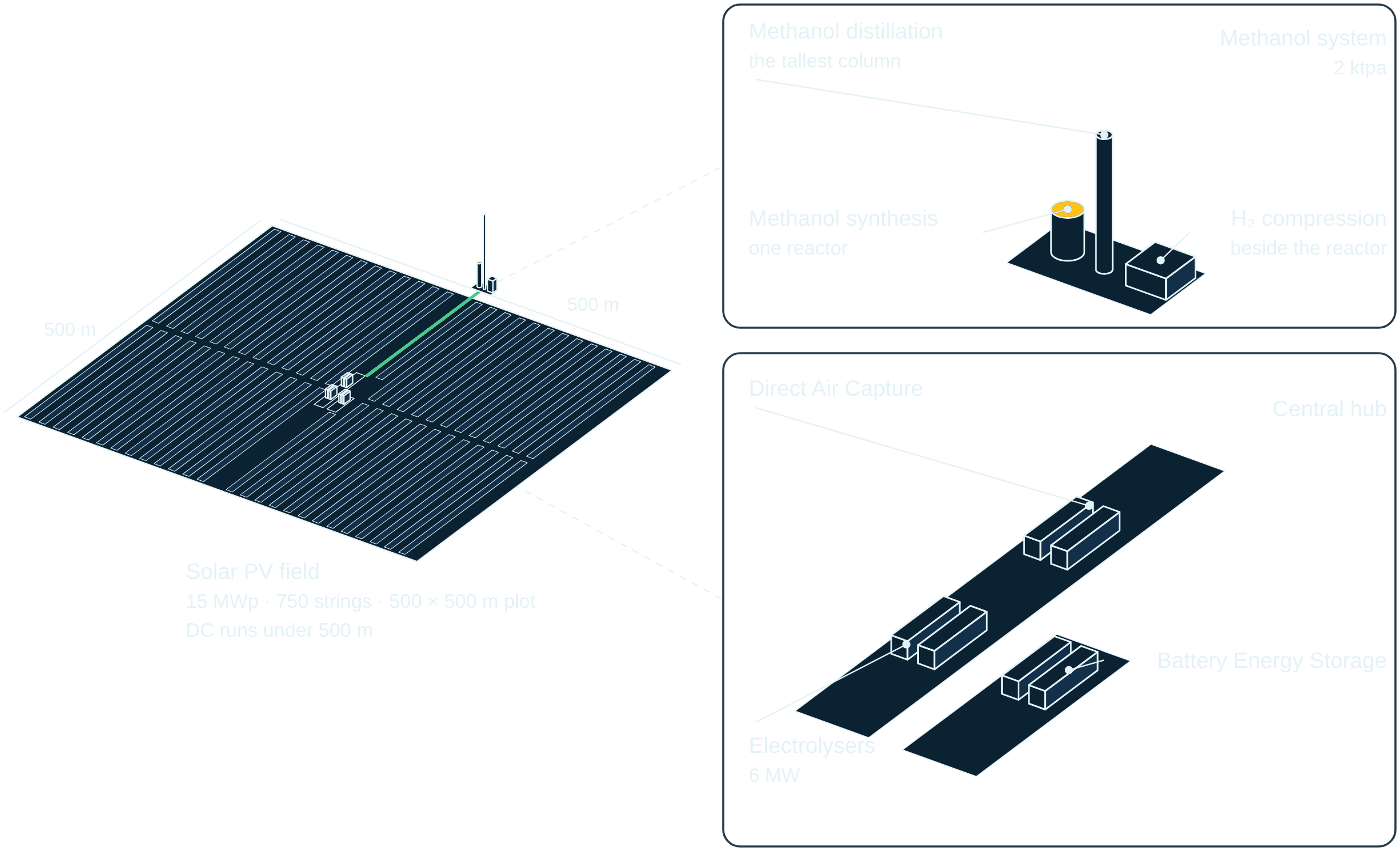
McDonald’s did not invent the burger, the bun or the fryer. It standardised them into one kitchen design that works the same everywhere, and replicated it. We do the same for e-methanol: factory-built components, integrated on site around a fixed 6 MW electrolyser, producing 2 ktpa per system. The whole system is off grid and sits within 500 m of DC cabling, with no grid connection, inverters, transformers or substations.
- Solar PV
- 15 MWp
- Battery storage
- 7.5 MWh
- Electrolyser
- 6 MW
- Direct air capture
- 3.2 ktpa CO₂
- DC cabling
- ≤500 m
- E-methanol output
- 2 ktpa
How we get there
Three mechanisms remove the large-scale premium and the bespoke premium
€800/t
Our target cost in series, about €140/MWh, to make e-fuel cheaper than the fossil fuel alternative
01
Lower electricity cost
Off-grid, DC-coupled solar PV and battery storage feed the electrolyser over no more than 500 m of DC cabling, with no grid connection to pay for.
02
Lower EPC cost and faster construction
Factory-built components, integrated to a fixed design. Permitting precedent and the commissioning playbook carry over between sites.
03
Multi-asset capex optimisation
One design across many sites lets us buy electrolysers, electronics and balance-of-plant components in volume, not once per site.
Shipping first
FuelEU Maritime creates a demand pool that only e-fuels can serve
1 January 2034
FuelEU Maritime
From this date, FuelEU Maritime sets a 2% RFNBO sub-target for ships calling at EU ports, which biofuels cannot satisfy. Until 2033, RFNBO energy counts twice towards a ship’s greenhouse gas intensity, which brings first demand forward.
2%
RFNBO sub-target from 1 January 2034, separate from the general greenhouse gas intensity target
1.7 Mt
E-fuel demand by 2034, bottom-up from the 2% sub-target applied to 41 Mt of in-scope marine fuel
About €1,550/t
The price ceiling a shipowner will pay, set by the fossil fuel price, EU ETS allowances and the avoided fine
The team
A team that has worked on both sides of industrial development, and now wants to get it right
Based in The Netherlands and Germany.

Co-founder and CTO
More than 10 years in electrolysers and e-fuels, at Sunfire and ENGIE

CFO
Awarded €132.5M in EU innovation grants; ten years’ cleantech due diligence experience.

Contact
Get in touch
Investors
We are raising a pre-seed round to take the first system to final investment decision.
Offtakers
We offer long-term, fixed-price offtake of e-methanol designed to meet RFNBO requirements, starting with the first 2 ktpa system in 2029.
Technology partners
We are selecting suppliers for electrolysis, direct air capture, synthesis, and solar PV with battery storage, for repeat orders across many sites.
Get in touch with us directly:
2034 isn’t moving.
The time to start is now.